Create a Dataset Using Stored Procedure
This guide walks you through creating a dataset in AIV using a stored procedure. Stored procedures centralize business logic in the database so your datasets stay simple and consistent.
What You’ll Learn
- What a stored procedure is and when to use it
- How to select a stored procedure and configure the dataset
- How to review, preview, save, and view your dataset
What is a Stored Procedure?
A stored procedure is a database object that contains one or more SQL statements stored and executed as a single unit. You can use it as the source for a dataset so that complex logic stays in the database.
| Characteristic | Description |
|---|---|
| Format | SQL statements stored in the database |
| Execution | Called by name (e.g., CALL GetAllProducts()) |
| Use case | Centralized logic, security, maintenance, reuse |
Why use stored procedures for datasets
- Centralize logic – Business rules live in the database; all datasets use the same logic.
- Improve security – SQL logic is hidden from end users.
- Simplify maintenance – Update the procedure once; all datasets reflect the change.
- Reuse result sets – Call the procedure by name instead of repeating complex SQL.
Prerequisites
Before you begin:
- Have the database connection for the target database (e.g., SampleDB) configured in AIV
- Know the procedure name, any parameters (and their types), and the output columns it returns
- Ensure the stored procedure already exists in the database you will select
Need to create or edit a procedure?
- Use MySQL Workbench (or another MySQL client)
- See Learn MySQL: the basics of MySQL stored procedures for help
Video Tutorial
Watch how to create a stored procedure in MySQL Workbench:
Steps to Create a Dataset Using Stored Procedure
Complete Step 1 (Navigate to the Dataset Section), Step 2 (Create a New Dataset), and Step 3 (Define Dataset Details) from the Create Dataset guide.
Step 1: Select Database Connection
Select the database connection that hosts your stored procedure (for example, SampleDB). Use the search bar to filter if you have many connections.
For details on selecting or creating database connections, see Database and Connected Sources.
Step 2: Select the Stored Procedure
- In the Dataset Editor, locate the Stored Procedures section in the left panel (Database Explorer).
- Select the required stored procedure.
- The Stored Procedure checkbox is automatically enabled.
- The system automatically generates the
CALLquery in the query editor.
Example – Without Parameters:
CALL GetAllProducts();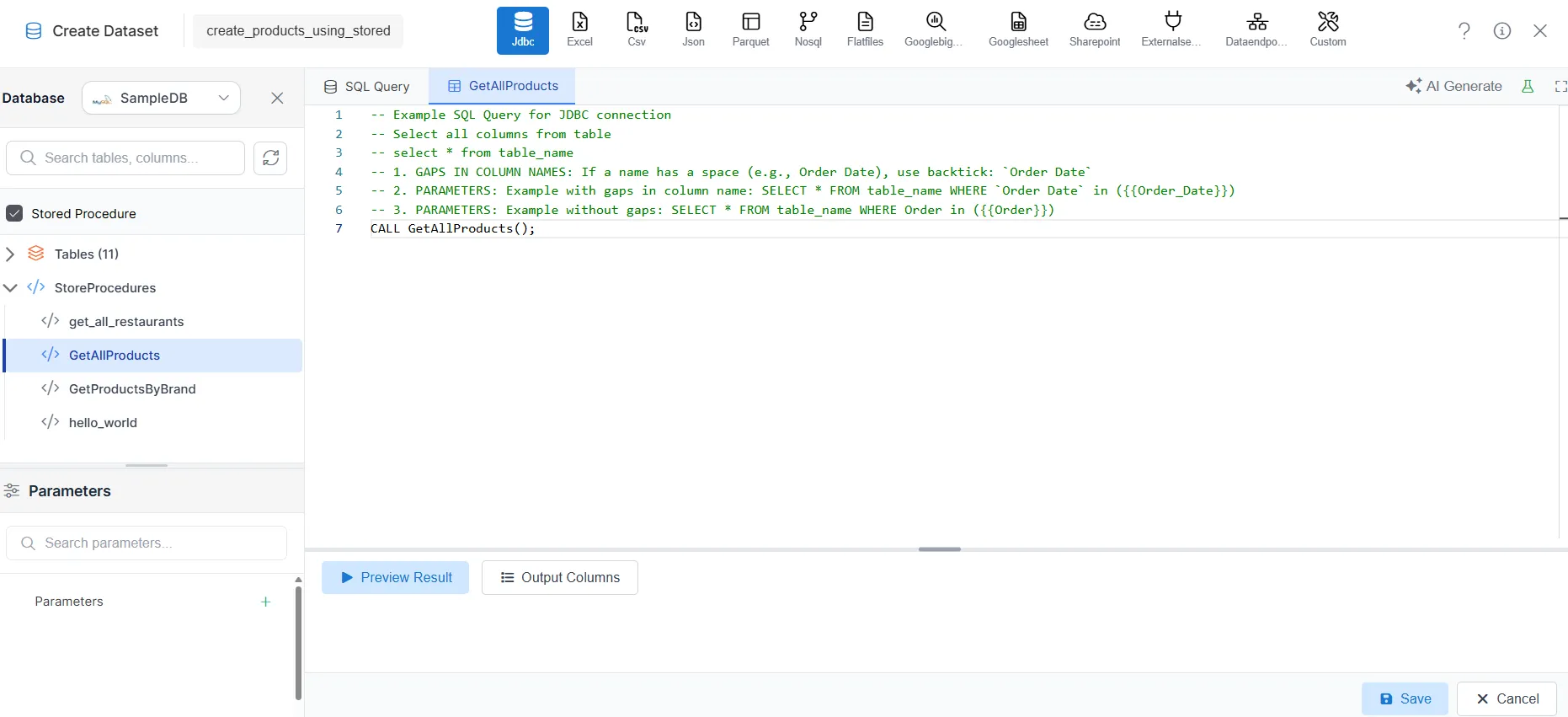
Example – With Parameters
-
Provide the required values in the generated
CALLstatement:CALL GetProductsByBrand('Levis');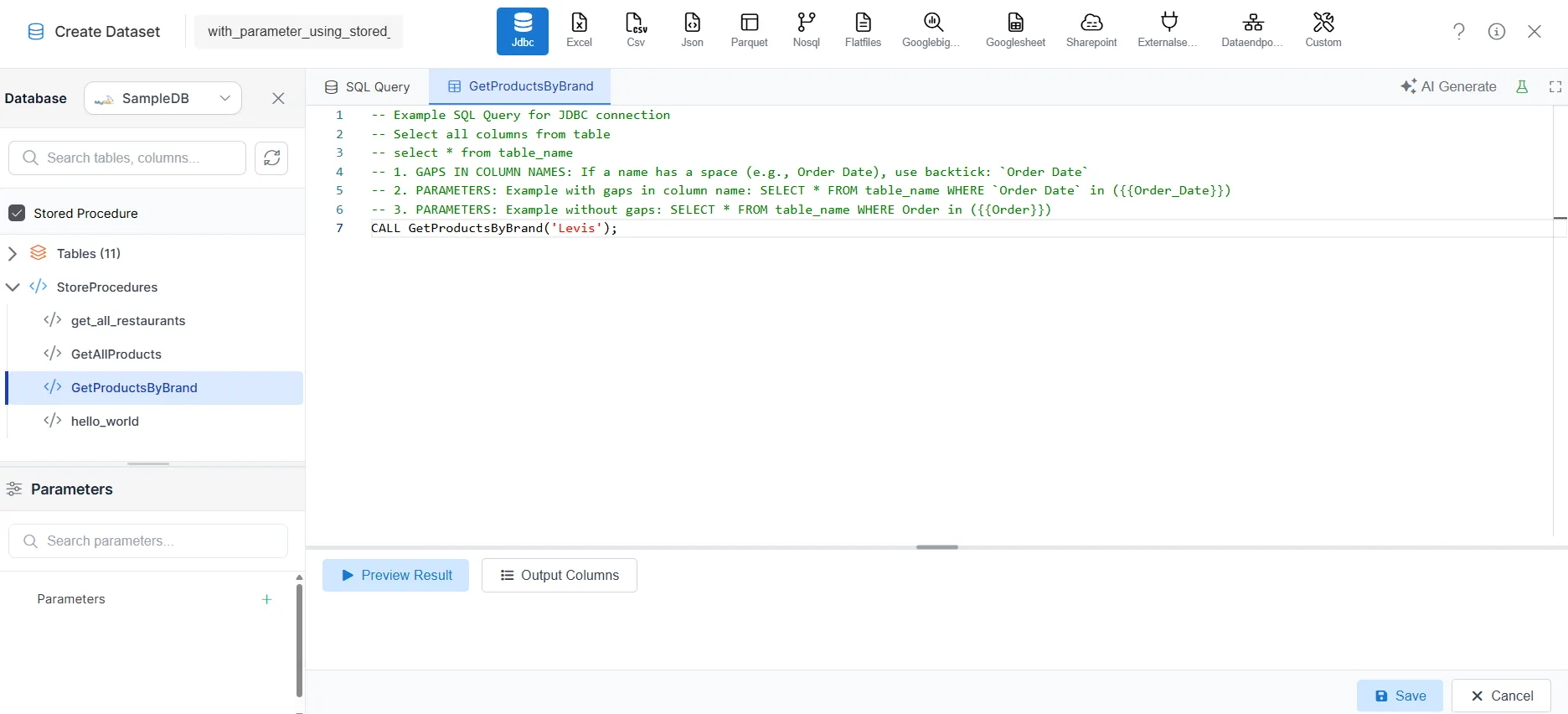
-
Only stored procedures available in the selected database are listed.
-
If the procedure has parameters, provide the required values before proceeding.
Step 3: Configure Output Columns
-
Open the Output Columns tab.
-
Review the columns returned by the stored procedure.
-
Optionally rename columns, adjust data types, apply formats, or disable columns not needed.
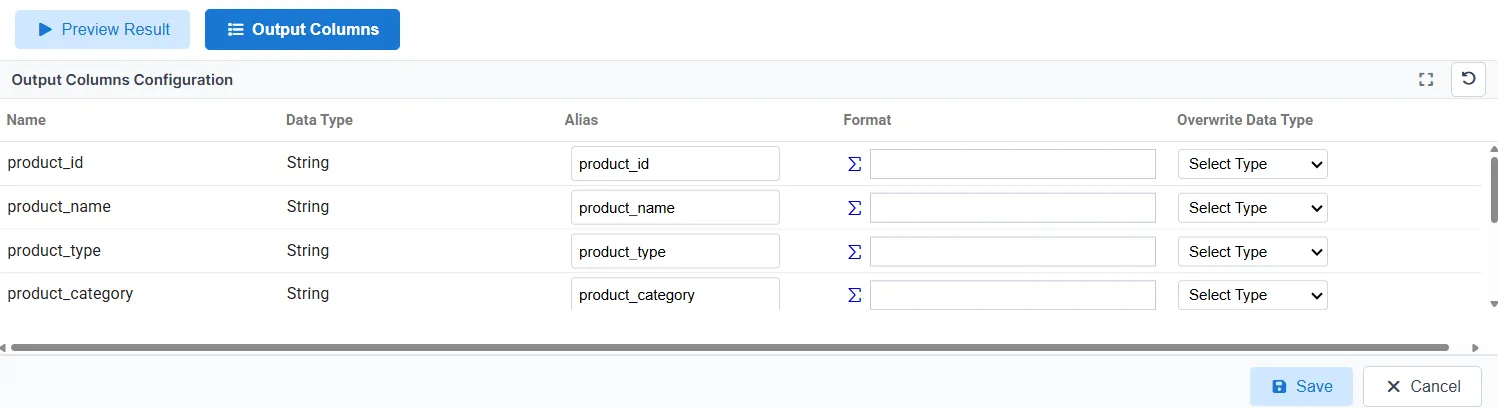
For detailed options, see Output Columns Tab Terminology.
Step 4: Preview the Result
-
Click Preview (or Preview Result).
-
Verify the result grid: correct rows, required columns, and expected data types.
-
Adjust parameters or output columns if needed and preview again.
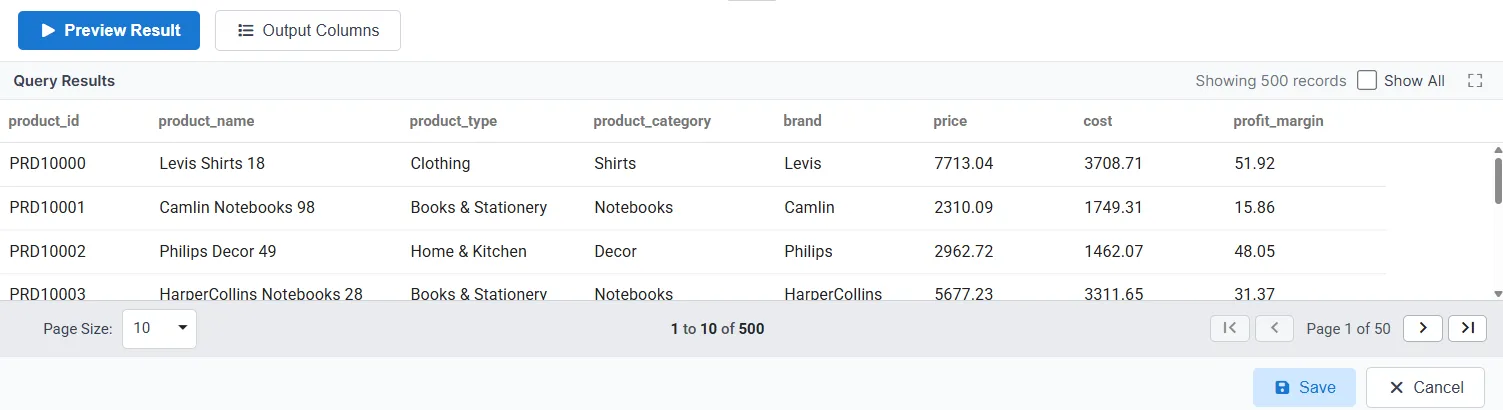
For detailed options, see Preview Tab Terminology.
Step 5: Save Dataset
- Click Save.
- In the Save Dataset dialog, optionally rename the dataset and select the destination folder.
- Click Save Dataset to confirm.
Step 6: View Your Dataset
- Go to the Dataset Grid view.
- Search for your dataset by name.
- Your dataset is now available for use in dashboards, reports, and visualizations.
Related Guides
Explore other ways to create datasets in AIV:
| Data Source | Guide |
|---|---|
| Drag & drop | Create Dataset |
| Excel | Dataset using Excel |
| CSV | Dataset using CSV |
| JSON | Dataset using JSON |
| Parquet | Dataset using Parquet |
| NoSQL | Dataset using NoSQL |
| Flat files | Dataset using Flat files |
| Google BigQuery | Dataset using Google BigQuery |
| Google Sheet | Dataset using Google Sheet |
| External sources | Dataset using External sources |
| View | Dataset using View |