Output Columns Tab Terminology
The Output Columns tab enables you to review and configure the structure of your dataset output before saving. It provides control over column names, data types, formatting rules, and transformation settings applied to query results.
This tab helps you:
- Standardize data presentation across dashboards and reports
- Improve readability with clear, business-friendly column names
- Ensure accuracy by validating data types and formats before publishing
- Prepare data for downstream analytics and visualizations
Refer to Create Dataset to navigate to the General Tab and access the Output Columns section.
Output Columns Interface
The Output Columns grid displays metadata for all columns returned by the dataset query.
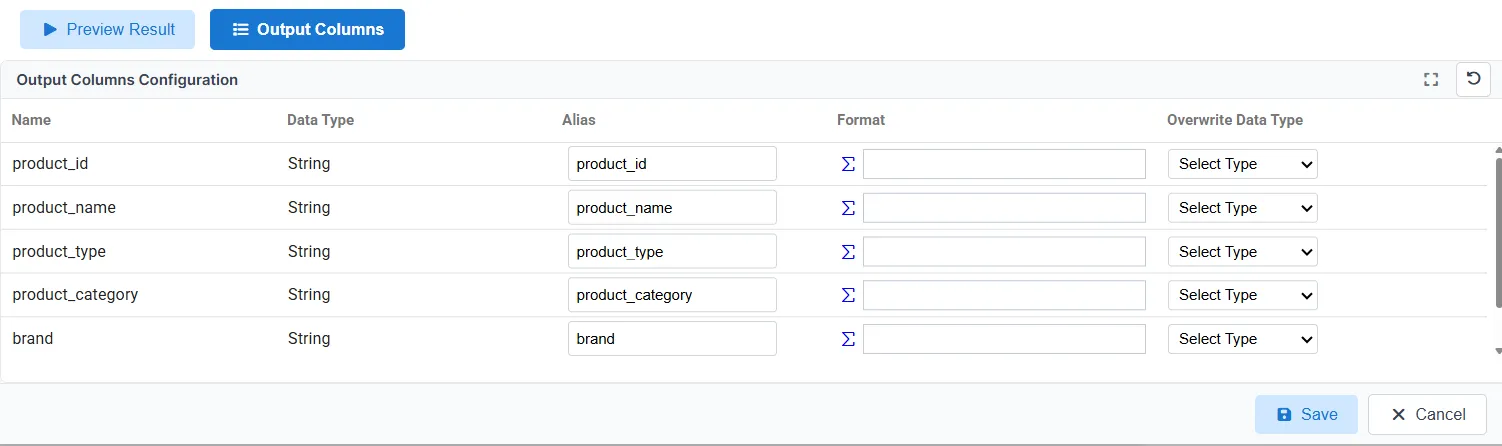
Each column includes the following configurable fields:
- Name
- Data Type
- Alias
- Format
- Overwrite Data Type
Column Definitions
Name
Purpose
The Name field displays the original field name as retrieved from the datasource or query result. This helps you trace the column back to the underlying table or query structure.
Key Points
- Reflects the actual database or query column name
- Remains unchanged unless you modify the Alias field
- Serves as the technical identifier for the column
Data Type
Purpose
The Data Type field indicates the system-detected data type of the column, ensuring that calculations, filters, and visualizations behave correctly.
Supported Data Types
- String – Text values
- Integer – Whole numbers
- Decimal – Numbers with decimal points
- Date – Date values without time
- Boolean – True/false values
- Timestamp – Date and time values
Key Points
- Automatically derived from the datasource schema
- Critical for accurate aggregations, comparisons, and visualizations
- Can be overridden using the Overwrite Data Type field
Alias
Purpose
The Alias field allows you to assign an alternate, business-friendly name to a column without modifying the original datasource structure.
Common Use Cases
- Improve readability for business users
- Apply consistent naming conventions across reports and dashboards
- Standardize column names across multiple datasets
- Create user-friendly labels for technical field names
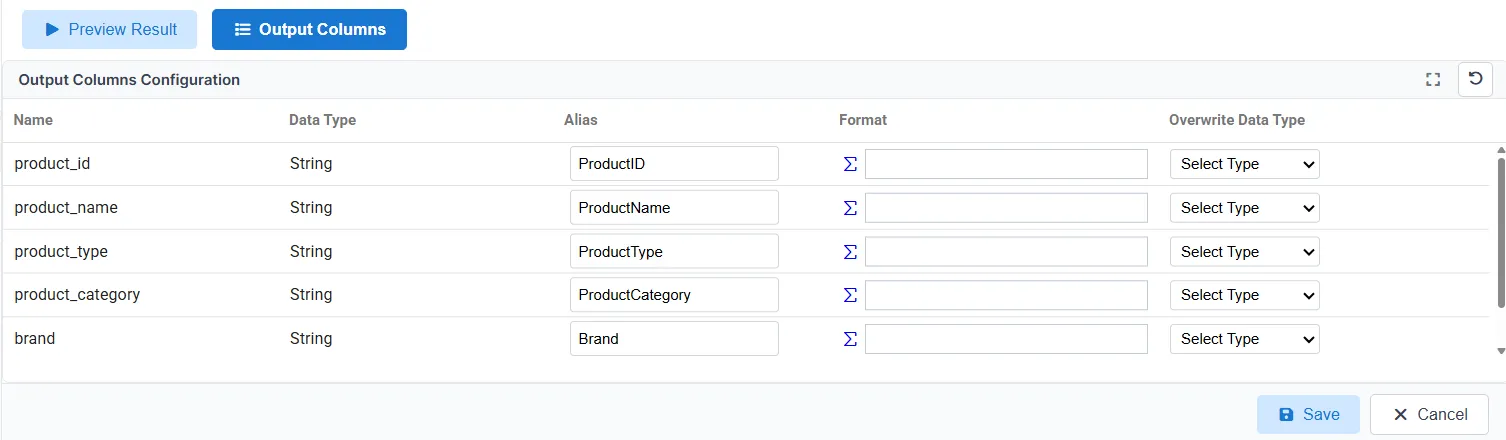
How to Modify an Alias
-
Double-click the value in the Alias column
-
Enter the new, business-friendly name
-
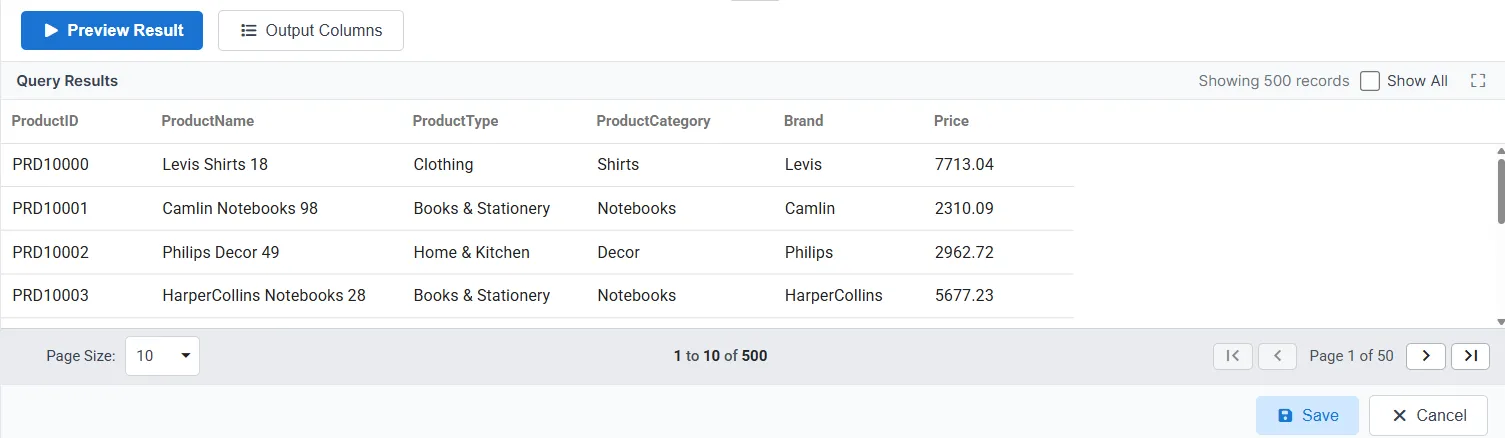
Click Preview Result to validate that the updated name appears correctly in the output
Key Points
- The original column name remains unchanged in the datasource
- Aliases appear in reports, dashboards, and exports
- Changes take effect immediately after saving the dataset
Format
Purpose
The Format field applies transformation expressions to String values, ensuring text is presented in a clean and consistent manner.
Availability
Format transformations are available only for String data type columns.
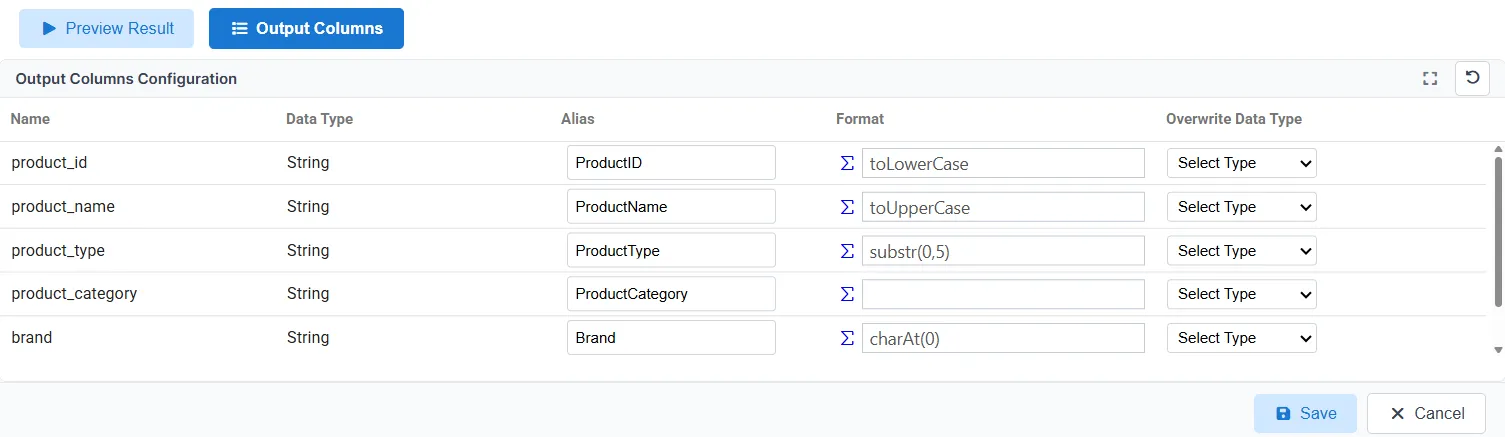
How to Apply Format
-
Click the expression (Σ) icon in the Format column for the desired field
-
Select the appropriate transformation from the available options
-
Click Preview Result to confirm the output meets your requirements
Available Format Options
-
Lowercase – Converts all characters to lowercase
Example:ProductID = PRD10000 → prd10000 -
Uppercase – Converts all characters to uppercase
Example:ProductName = Levis Shirts 18 → LEVIS SHIRTS 18 -
charAt(position) – Extracts the character at the specified position (index starts from 0)
Example:Brand = Levis → charAt(0) → L -
substr(start, length) – Extracts a substring starting from a given position for the specified length
Example:ProductType = Clothing → substr(0, 5) → Cloth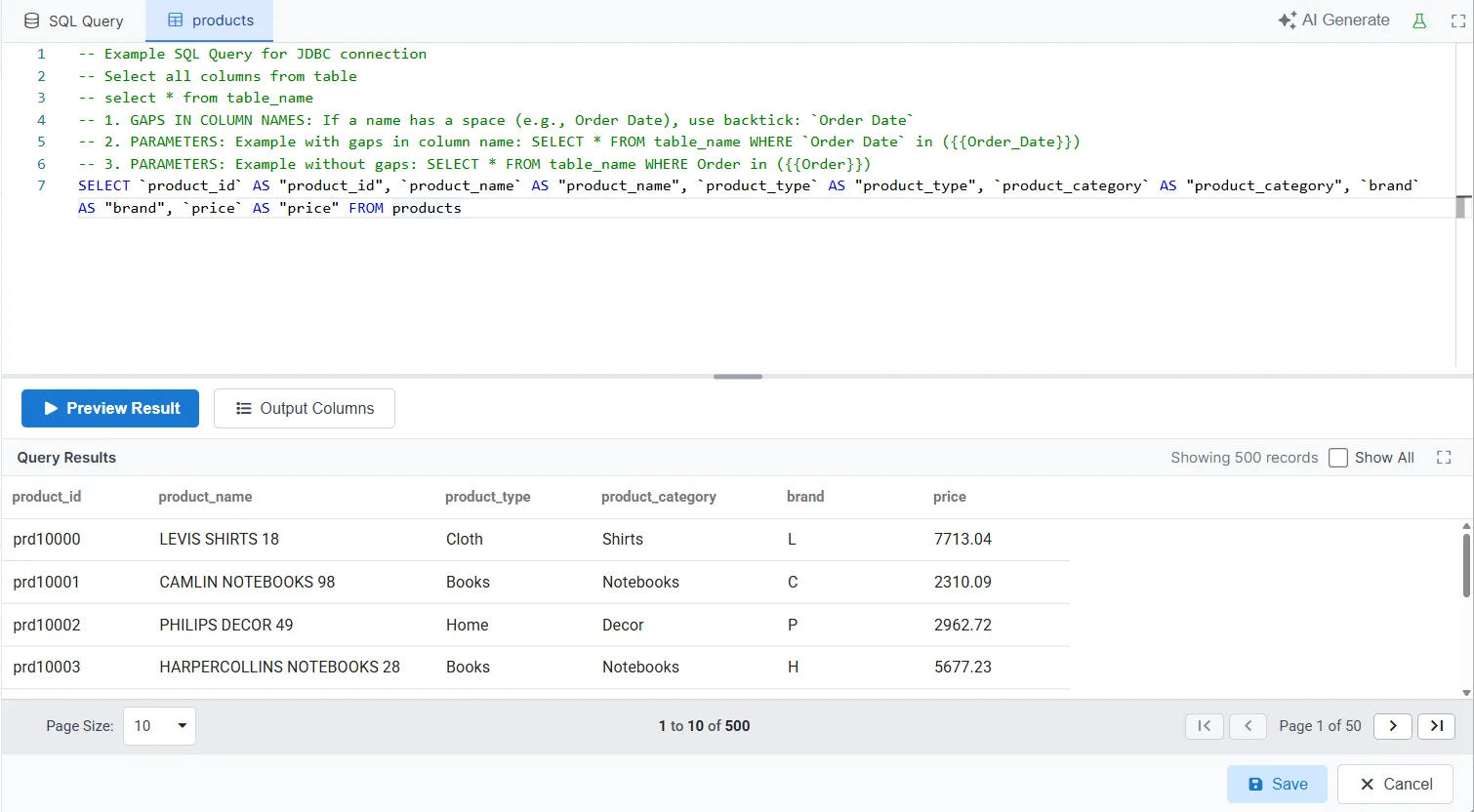
Key Points
- Format transformations apply at query execution time
- Multiple columns can have different format rules
- Original data in the datasource remains unchanged
- Always preview results before saving to ensure expected output
Overwrite Data Type
Purpose
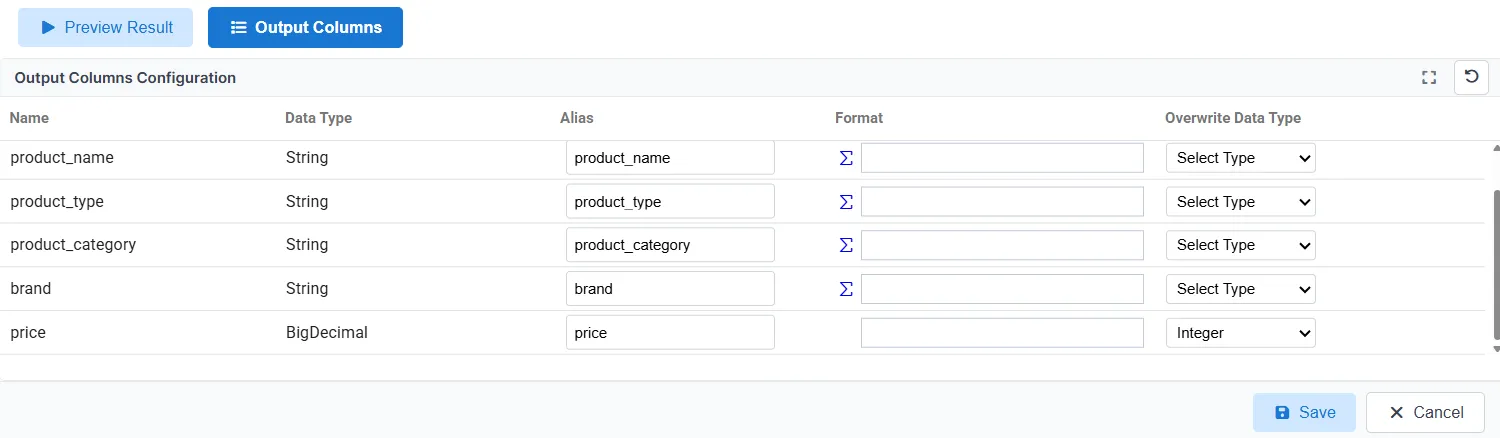
The Overwrite Data Type field allows you to redefine the data type of a column by selecting a different type from the dropdown list.
When to Use
- The system-detected data type is incorrect
- A column requires conversion for reporting or visualization purposes
- Data type adjustments are needed for calculations or aggregations
- You need to ensure compatibility with downstream systems
Common Examples
- Convert a
Stringcolumn containing dates toDateformat - Change a
Decimalcolumn toIntegerfor simplified display - Adjust a
Timestampcolumn toDateto remove time components - Convert numeric
Stringvalues toIntegerorDecimalfor calculations
How to Apply Overwrite Data Type
-
Click the Overwrite Data Type dropdown for the desired column
-
Select the target data type from the list
-
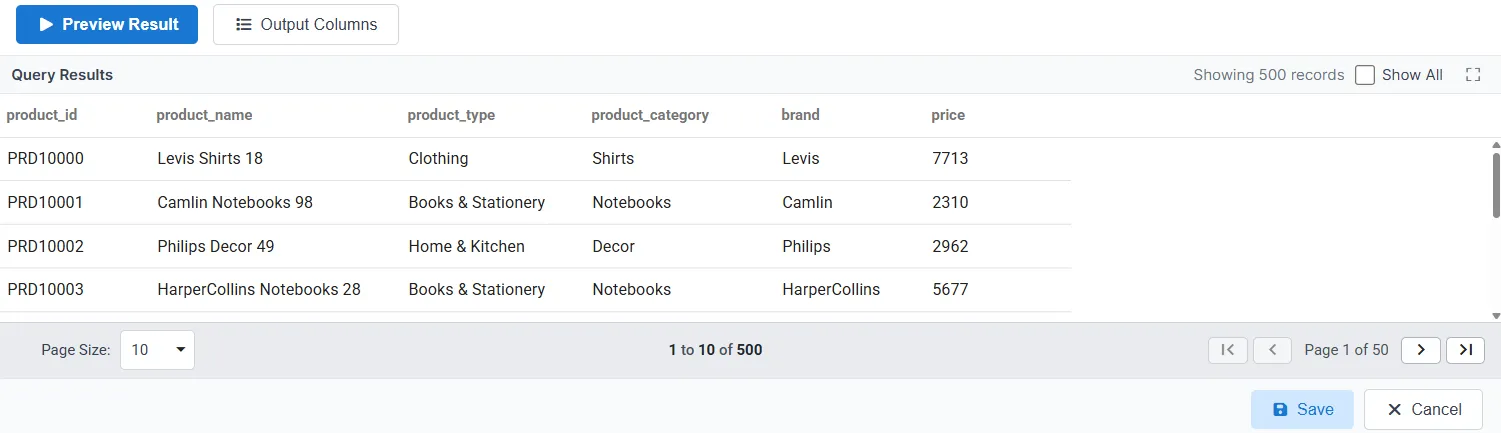
Click Preview Result to validate the conversion before saving
Key Points
- Ensure the source data is compatible with the target data type
- Incompatible conversions may result in null values or errors
- Preview results carefully to verify successful conversion
- Original datasource data types remain unchanged
Reset
Purpose
The Reset function discards all changes made in the Output Columns tab and returns the configuration to its original state.
What It Affects
Reset undoes all modifications applied in the Output Columns tab, including:
- Alias updates
- Format transformations
- Overwrite Data Type selections
When to Use
- You want to start over from the original query output configuration
- You are not satisfied with the current changes and prefer to revert completely
- You need to undo multiple changes quickly without manual reversal
Key Points
- Reset is irreversible once confirmed
- Only affects Output Columns settings; other dataset configurations remain unchanged
- Consider reviewing changes before using Reset to avoid losing intended modifications
Summary
The Output Columns tab ensures that your dataset output is:
- Properly structured with clear, meaningful column names
- Correctly typed for accurate calculations and visualizations
- Consistently formatted for business user comprehension
- Ready for analysis across dashboards, reports, and downstream applications
By carefully reviewing and configuring this tab, you can deliver high-quality, analysis-ready datasets that meet the needs of your organization.